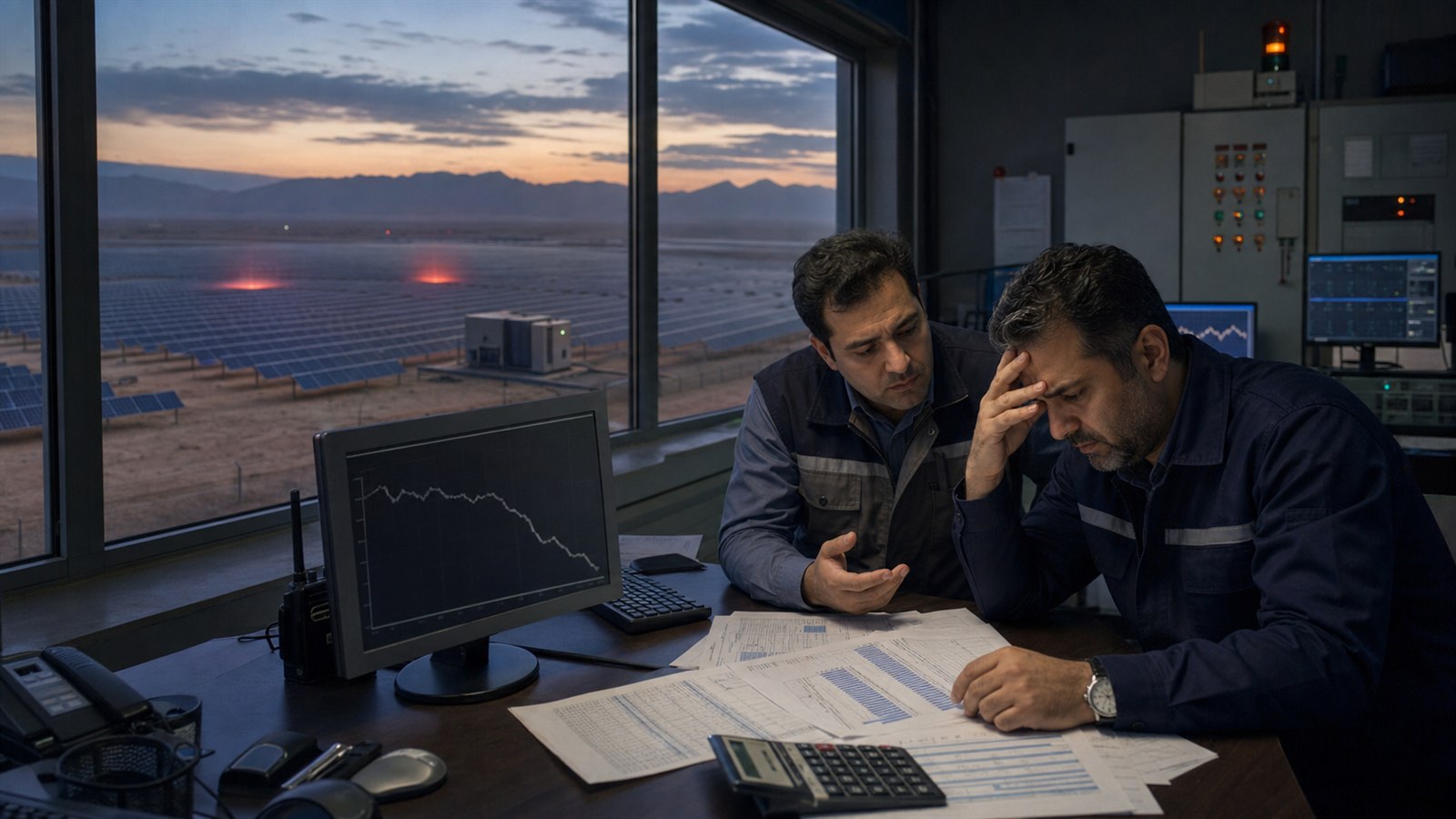
It was after six in the evening when the plant owner placed the monthly sales report on the desk and looked at the operator.
“The weather was not unusually bad, and we had no major shutdown. So why is this month's production below forecast?”
The operator paused before answering. “The inverters were online most days. Their lights were green whenever we visited the site. Maybe the modules were dirtier, or perhaps the temperature was higher... I cannot say for certain.”
That was precisely the problem: “I cannot say for certain.”
The plant was not offline. Switchboards were operating, inverters were starting, and the revenue meter was still recording energy. Yet part of the income was quietly disappearing every day.
The owner put it this way: “If a machine stops completely, at least we notice. What worries me is a fault that never shuts down the plant—it just takes a little production and revenue from us every day.”
This is a familiar frustration for plants that have generation equipment but lack the eyes and memory needed to understand how that equipment is actually performing.
A solar plant can be online without being healthy
Without comprehensive monitoring, operators may know only that the plant is producing electricity. They do not know whether it is producing as much as it should.
For example:
- An inverter may trip and restart for several hours each day.
- One or more strings may deliver less current than their peers.
- A DC fuse or connector may be deteriorating.
- Some modules may be affected by shading, soiling, hotspots, or bypass-diode failure.
- An inverter may derate at high internal temperature without fully shutting down.
- An irradiance or temperature sensor may be out of calibration and distort performance calculations.
- Communication with a device may be lost without anyone being notified.
- Inverter control settings or a grid limitation may be reducing output.
The main revenue meter shows only the final result. It does not explain which asset reduced production, when it happened, or why.
The U.S. Department of Energy's Federal Energy Management Program notes that without metering and monitoring, a site may not be notified when a PV system is offline or production drops significantly—creating both performance and potential safety concerns.[1]
The operator's frustration: “A few numbers cannot tell me the cause”
“Management asks why production is down, but I only have the revenue meter and several separate inverter portals. I switch between systems, take screenshots, copy values into spreadsheets, and compare them with previous days. Even then, I cannot be sure whether the loss came from weather or equipment.”
When irradiance, module temperature, AC and DC power, string current, inverter status, and meter data are not brought into one platform, diagnosing underperformance becomes difficult.
Lower power on a cloudy day may be normal. The same reduction under strong irradiance may indicate a fault. Without comparing actual production with expected production under the same conditions, the two situations can look identical.
Maintenance then shifts from proactive and data-driven work to reacting after a failure has already become visible.
Cost one: energy that can never be recovered
Lost generation cannot be produced again on another day. If a fault remains undetected for two weeks, repairing it does not recover those two weeks of missing energy.
A simple illustrative calculation
Assume a 1 MW plant has the equivalent of five full-production hours per day:
1 MW × 5 hours × 30 days = 150 MWh
If a hidden problem reduces production by only five percent:
150 × 5% = 7.5 MWh of lost energy
The financial loss is: 7.5 MWh × the sales value of each MWh
This example does not assume a particular tariff or plant design. It simply shows how a small percentage loss can accumulate into a material amount over months and years.
IEA PVPS guidance similarly describes lost sales revenue as the gap between actual and guaranteed MWh multiplied by the unit electricity sales price.[2]
Cost two: later and more expensive repairs
A problem detected early may require only a targeted visit, cleaning, connection repair, or replacement of a minor part. Left unresolved for months, the same issue may cause secondary damage, a long outage, or replacement of expensive equipment.
Common examples include:
- Rising resistance at a connection and abnormal heating
- Repeated ground faults without root-cause investigation
- Inverter overheating caused by blocked ventilation
- Gradual string failure that remains hidden in total plant output
- Continued operation with sensors outside calibration
- Repeatedly resetting an alarm without recording and diagnosing its cause
The U.S. Department of Energy advises that events such as trips and ground faults should not be handled by simply switching a system off and back on, because a reset is unlikely to correct the root problem.[3]
Cost three: unfocused site visits and disputes between teams
Without precise alarms and historical data, a maintenance team may receive little more than: “Production is down—please investigate.”
Which area? Which inverter? Which string? Since what time? Under what irradiance and temperature?
The result can be unnecessary travel, inspection of healthy equipment, repeated visits for more information, trial-and-error replacement of parts, longer downtime, and disputes among the owner, EPC contractor, and O&M team.
A comprehensive system should identify the affected area and time, preserve the related measurements, and show the event history before technicians travel to the site. Better context shortens mean time to repair and makes maintenance more targeted.
Cost four: no evidence for performance and warranty claims
“The contractor says production is normal. Operations says the equipment is at fault. The inverter manufacturer asks for complete logs, but we do not have them. In the end, no one accepts responsibility.”
In EPC, O&M, insurance, and warranty agreements, reliable data is not just material for a dashboard—it is evidence.
Without a consistent archive, the owner may be unable to demonstrate when underperformance began, which alarms were recorded, how long the contractor took to respond, or whether the cause was weather, grid curtailment, soiling, or equipment failure.
An NREL assessment of 75 federal PV systems reported that some sites struggled to resolve inverter and other failures in time and consequently lost several months of generation. In many cases, production returned to expected levels after repairs.[4]
Cost five: financial decisions based on guesswork
Without comprehensive monitoring, a financial report may show only how much electricity was sold. It cannot answer the more important questions:
- How much energy should the plant have produced?
- How much was lost to equipment downtime?
- How much loss came from soiling or high temperature?
- Is module cleaning economically justified right now?
- Which inverter is underperforming?
- What is the revenue impact of every hour of downtime?
- Is the plant still following its original financial model?
Monitoring platforms can combine lost production with tariff information to calculate the financial value of downtime or reduced output. This is where technical data becomes a financial decision tool.[5]
What should comprehensive monitoring give the owner?
An effective platform is more than a collection of colorful charts. At a minimum, it should:
- Compare actual production with expected production.
- Calculate availability and performance ratio.
- Present inverters, strings, meters, and auxiliary equipment in one view.
- Alarm on communication loss, plant shutdown, inverter stops, and low PR.
- Include irradiance, ambient temperature, and module temperature in analysis.
- Preserve faults, events, and maintenance history.
- Calculate the energy and revenue impact of each event.
- Produce auditable technical and management reports.
- Reveal recurring faults and abnormal trends.
- Assign responsibility, response deadlines, and maintenance work orders.
IEA PVPS identifies communication loss, plant shutdown, inverter stops, and low performance ratio among the minimum alarms expected from a monitoring system.[2]
Monitoring alone is not enough
Software without a response process is like installing a camera that nobody watches.
Sensors must be calibrated, alarms must be prioritized, responsibility must be assigned, and response times must be defined. Incorrect data—or an alarm that no one acts upon—can be almost as damaging as having no monitoring at all.
The end of the story
Several weeks later, the source of the production loss was found: one inverter was derating during the hottest hours of the day, while two strings were producing less current than their peers. None of them had failed completely, so routine visits had not revealed the problem.
After seeing the final report, the owner said: “The real cost was not just repairing the inverter. It was every day we did not know what was happening inside our plant.”
A solar power plant is a long-term investment. Modules may remain in the field for more than two decades, but the investment delivers its expected return only when the owner understands how the asset is performing.
The absence of comprehensive monitoring does not always shut down a plant overnight. The greater risk is that the plant keeps running while quietly producing less, taking longer to repair, and earning less than it should.
Do you have a complete view of your solar plant?
Request information or a demonstration to review your plant's monitoring needs and explore Harmony SCADA capabilities.
Request information and demoReferences
- U.S. Department of Energy — Metering for Federal Solar PV Systems in Remote Locations
- IEA PVPS Task 13 — Guidelines for Operation and Maintenance of Photovoltaic Power Plants
- U.S. Department of Energy — Operate and Maintain an Existing Photovoltaic System
- NREL — Understanding Solar Photovoltaic System Performance: An Assessment of 75 Federal Photovoltaic Systems
- U.S. Department of Energy — Monitoring Platforms for Solar Photovoltaic Systems