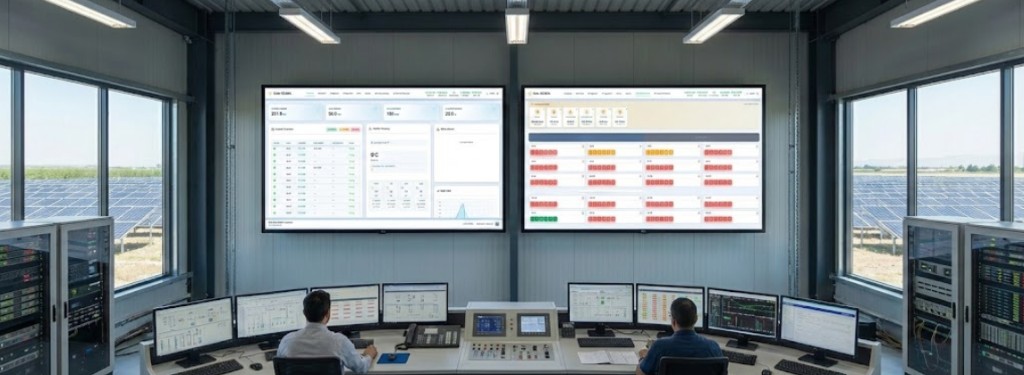
The SCADA system (Supervisory Control and Data Acquisition) acts as the operational brain of a solar power plant. It provides real-time monitoring, remote control and analysis of production data.
Definition of SCADA
SCADA is a software-hardware architecture that connects to equipment via communication protocols (such as Modbus TCP/RTU), collects data and displays it in an integrated graphical interface. In a solar plant, this equipment includes inverters, pyranometer, switchgear and environmental sensors.
Main SCADA Components
- RTU/PLC: Remote control units that communicate with field equipment
- SCADA Server: Data collection and storage center
- HMI: Human-Machine Interface for display and control
- Communication Protocols: Modbus TCP, Modbus RTU, OPC, etc.
Applications in Solar Plants
- Display real-time power and daily energy per inverter
- String monitoring and identification of underperforming panels
- Automatic alarm on faults
- Reporting for investors and regulators
- Remote control (start/stop, switchgear)
- Key indicator calculation such as PR (Performance Ratio)
Why is SCADA essential for solar plants?
In a multi-megawatt plant with dozens or hundreds of inverters, manual management is impossible. SCADA enables professional management through automated data collection, status display and alarm delivery, optimizing production and reducing O&M costs.
Summary
SCADA is essential for every commercial-scale solar plant. Choosing a comprehensive solution like Harmony SCADA that supports multiple inverter brands, generates Excel/PDF reports and offers string monitoring and site map is a smart investment for owners and operators.